 Xpress News24
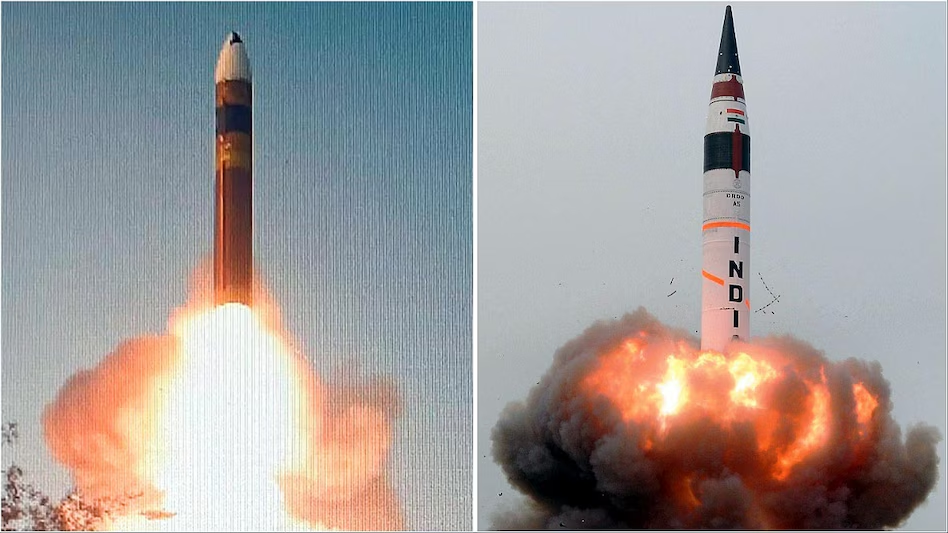
India’s nuclear arsenal is estimated to have reached around 190 warheads, according to the latest assessment by the Federation of American Scientists (FAS). The estimate places India among the world’s nine nuclear-armed states and points to a gradual expansion and modernisation of its nuclear forces.
The figure is an estimate rather than an officially confirmed number. India does not publicly disclose the exact size of its nuclear weapons stockpile, making independent assessments by organisations such as FAS an important source for understanding the country’s nuclear capabilities.
FAS’s 2026 global assessment estimates that India has 190 nuclear weapons in its total inventory, including around 178 warheads in the military stockpile. The organisation also stresses that estimating India’s arsenal involves considerable uncertainty because neither the Indian government nor Western governments publicly provide detailed figures on the country’s nuclear stockpile.
The assessment is based on publicly available information, including government statements, defence-related data, satellite imagery and other open-source material. FAS’s previous India-specific Nuclear Notebook, published in 2024, had estimated that India had likely assembled around 172 warheads and had produced enough weapons-grade plutonium for potentially more.
Why the 190 figure matters
The increase in the estimate comes against the backdrop of India’s continuing nuclear modernisation programme. India has been developing and deploying a mix of land-based ballistic missiles, aircraft-based systems and sea-based capabilities.
FAS’s latest assessment says India operates several nuclear-capable delivery systems and is continuing to develop additional systems. The organisation has previously identified systems such as the Agni series and India’s sea-based ballistic missile capability as part of the country’s developing nuclear triad.
However, the number of warheads should not be confused with the number of weapons permanently mounted on missiles.
According to FAS, nearly all Indian nuclear warheads are believed to be kept in central storage rather than routinely mated with missiles. The organisation says a small number could potentially be carried on one ballistic-missile submarine during a deterrent patrol, while bomber-delivered weapons could probably be employed relatively quickly.
This distinction is important when assessing India’s nuclear readiness. A larger stockpile does not automatically mean that an equivalent number of nuclear weapons are deployed and ready for immediate launch.
New missiles and the expanding nuclear triad
India’s nuclear modernisation has focused on strengthening all three legs of its strategic deterrent — land, air and sea.
The country’s Agni missile family forms a major part of its land-based nuclear-capable force, while the development of newer systems is aimed at improving mobility, range and survivability. At sea, India’s ballistic-missile submarine programme is intended to provide a more survivable second-strike capability.
FAS’s earlier India assessment noted that at least five additional nuclear-capable systems were under development, with several expected to move closer to operational deployment.
The organisation’s 2026 global assessment also says India is among the nuclear-armed states believed to be increasing its stockpile, even as the country’s declared nuclear posture remains centred on deterrence.
No official confirmation from India
The FAS numbers should therefore be treated as an independent estimate, not an official disclosure.
India’s nuclear policy has traditionally emphasised credible minimum deterrence and a stated no-first-use posture, although the precise operational arrangements surrounding its nuclear forces remain classified.
The latest estimate nevertheless highlights a broader trend: India is continuing to modernise its nuclear forces while developing more advanced delivery systems. As newer land- and sea-based platforms become operational, the structure and readiness of India’s nuclear deterrent are likely to attract continued international attention.
For now, the exact number of Indian nuclear warheads remains known only to the government and the country’s strategic establishment. The FAS estimate of around 190 provides an outside assessment of the scale of the arsenal, but the actual figure could be higher or lower.