 Xpress News24
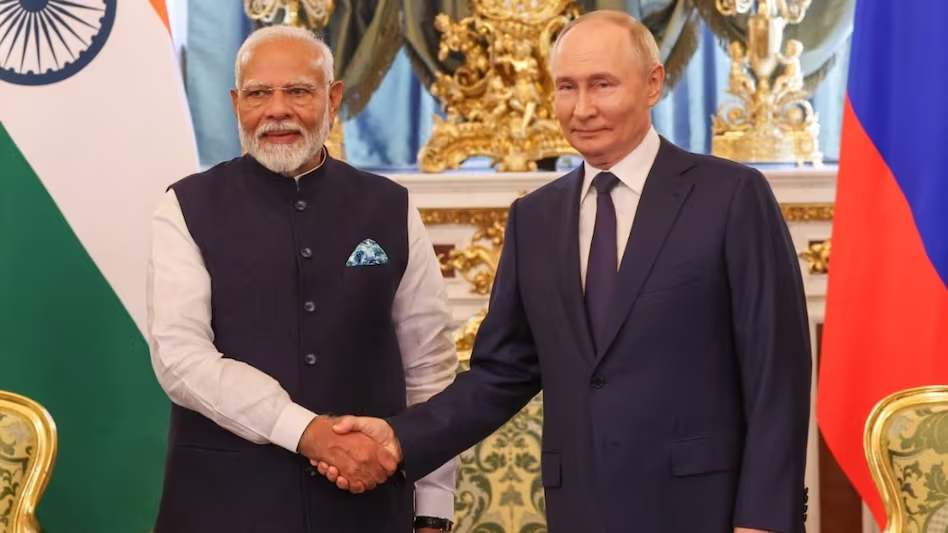
New Delhi: Defence cooperation is expected to remain at the centre of Russian President Vladimir Putin’s India visit, with his bilateral meeting with Prime Minister Narendra Modi likely to focus on military equipment, technology transfer, energy security and the future of the decades-old strategic partnership.
The talks come at a time when India is seeking to strengthen domestic defence production while maintaining access to advanced military technology. For Moscow, the visit is an opportunity to deepen one of its most important partnerships in Asia amid continuing geopolitical tensions and Western sanctions.
Defence is expected to be among the key subjects discussed by Modi and Putin during their bilateral meeting on Friday. While several proposals are under discussion, the exact agreements and announcements will depend on the outcome of the talks.
One of the closely watched issues is Russia’s offer of the Sukhoi Su-57, its fifth-generation fighter aircraft. India and Russia have been discussing possible cooperation around the aircraft, including potential procurement and technology-related arrangements. Any progress on the proposal could have significant implications for India’s future fighter fleet and indigenous aerospace capabilities.
The two sides are also expected to discuss the next generation of the BrahMos programme. The missile project, jointly developed by India and Russia, has become a major example of defence cooperation moving beyond a conventional buyer-seller relationship.
The S-400 air defence system is another important area of interest. India already operates the Russian-made system, and future cooperation related to air defence capabilities is likely to remain part of the broader defence dialogue.
Beyond individual platforms, both countries are looking to expand cooperation in defence research, development and manufacturing. New Delhi has increasingly pushed for technology transfer, joint production and greater domestic manufacturing instead of remaining dependent on direct imports.
That shift is important for India as it seeks to build a stronger defence industrial base. Russia, meanwhile, remains a major source of military technology and equipment for the Indian armed forces, although India has been diversifying its defence procurement in recent years.
Energy is expected to form the second major pillar of the Putin-Modi discussions.
Despite pressure from Western countries, India and Russia have maintained substantial energy ties, particularly in crude oil. Long-term cooperation in the energy sector could figure prominently in the talks as India attempts to secure reliable supplies while managing global price and geopolitical risks.
Nuclear energy is another area where the two countries are expected to explore deeper cooperation. Discussions on additional nuclear power projects in India could receive attention during the visit, building on the long-standing partnership between the two countries in the civilian nuclear sector.
The economic relationship will also be under focus.
Commerce and Industry Minister Piyush Goyal said India and Russia are moving towards finalising a new bilateral investment agreement. He also said the two countries have set a target of taking bilateral trade to $100 billion by 2030.
Speaking at the plenary session of INNOPROM India 2026 in New Delhi on Thursday alongside Russian Industry and Trade Minister Anton Alikhanov, Goyal said bilateral trade is currently around $60 billion. Reaching the 2030 target would require substantial growth in trade over the next four years.
The investment agreement is expected to provide a framework for expanding economic engagement beyond the current concentration in energy. Manufacturing, technology, pharmaceuticals, agriculture and other sectors could gain from deeper investment flows.
For India, the larger challenge is balancing strategic autonomy with growing geopolitical pressures. New Delhi has maintained its independent foreign policy despite differences among major global powers, while Moscow continues to regard India as a key strategic partner.
Putin’s visit will therefore be closely watched not only for individual defence or energy announcements but also for indications of where India-Russia ties are headed over the next decade.
The immediate focus will be on what concrete decisions emerge from the Modi-Putin meeting, particularly in defence production, technology cooperation, energy and investment. Further details are expected after the bilateral talks.